Offering Online Therapy

I offer HIPPA compliant Video Sessions for simple and secure session for for all new and returning clients. No download required. Please contact me for more information or if you would like to schedule an appointment or consultation. Thanks you! Greg Carpenter LMFT

Friday, May 1, 2020

"Keep Your Eye on the Ball"

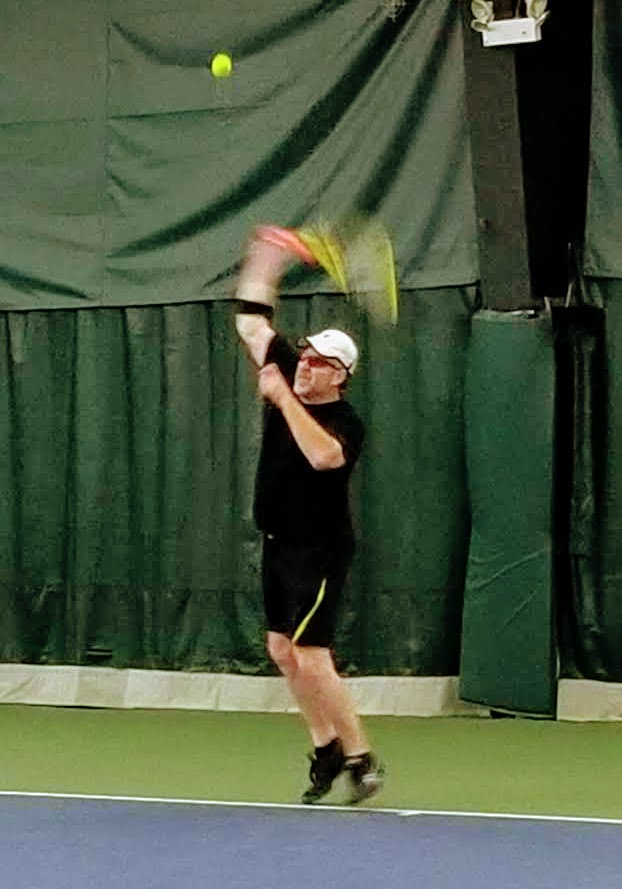
What is wrong in this photo? If you play tennis, you will notice that I failed to follow rule no. 1, keep your eye on the ball through the point of contact. In the top photo, I have taken my eyes off the ball. It is clear that I am looking forward before I have made contact.
Now why would someone who has played tennis since high school do that? Looking back, I was having a bad serving day and the guy across the net had just slammed two passing shots by me and my doubles partner (which never feels good). Even though my conscious mind knows better, my subconscious mind is directing my body to looking forward in anticipation of the next shot (the threat).
Right now during this pandemic many of us feel like we have been slammed. These are unprecedented times. Even my 95 year old father who was a medic in WWII says that he never experienced anything like this.
Each day we wake up, there is an energy tax that takes up twenty per cent of our energy and attention (without any additional problems). During this unprecedented time of uncertainty, it is hard to not look ahead and try to anticipate the looming threats. Events, news and too many changes to name can trigger past wounds, subconscious negative beliefs that hijack our minds and bodies into a fight, flight or freeze response.
There is no easy foolproof way to manage this global crisis. When people start to lose their center, they respond by getting angry, anxious or numb (emotionally remote). There is nothing wrong with any of these normal responses to abnormal times. Sometimes you need anger to help you set boundaries. Or maybe you need the adrenaline of fear to help you run faster. Maybe you need to shut off your feelings to cope and get your work done.
Emotions are meant to show up, keep us safe and give us important information. When we are centered, they drop off a packet of information, flow through us and leave. Imagine if the UPS person dropped off a package and then took out a lawn chair and hung out on your porch. It might be novel at first, but eventually we would be asking this person to leave.
The problem is when we get stuck in our emotions of anger, fear or a spacey brain fog. We have let our nervous systems go into overdrive and run our thoughts and emotions.
Being self-employed, my mind will wander into the "what if" story about the future. When this happens, I remind myself - "it is not happening now." I check in with myself to discern the difference between planning, problem solving and worrying. Most of the time, it is worry. If I catch it early enough, redirecting my thoughts brings me back to center. If my story about the future grabs hold of my nervous system, then I shift to brainstorming ways to reboot my mind and body.
My favorite go to tools when this happens is exercise (usually tennis), tapping on acupoints while I focus on my thoughts, feelings or body sensations, listening to relaxing brainwave entrainment music or playing many of my sound therapy instruments. I also like to hike and take pictures of nature. All of the above get me out of my head/thoughts/emotions and back into the moment.
Today, Facebook popped up a prior post from 2013 that I shared. It was written by Loretta LaRoche, who is a Wellness advocate and humorous public speaker. What she wrote seven years ago applies even more during this pandemic.
"Five ways you can live a calmer life : 1. Think about what you're thinking about. We have 60,000 thoughts a day! Many are irrational. 2. Take a news fast. You can allow yourself not to be disturbed. 3. Don't try to fill every moment. You are allowed to savor emptiness and have some unexpressed thoughts. 4. Care less about what THEY say and more about being authentic. 5. Discover your inner sitcom. Become the court jester and help lighten up the world. Loretta."
In the bottom photo, you will notice that I am keeping my eye on the ball. In order for us to accomplish this in life, we need to know what is most important to us. What is it that we most want to experience and feel? So often we become driven by avoiding what we don't want to experience and feel.

Even in a crisis we have choices about what we focus and keep our "eyes" on. Notice what you are paying attention to and what amps you up in negative ways. For me, I very seldom watch the Coronavirus TV coverage because it is just too sensationalized and focused on fear. Instead, I get my news from reading; it has much less of negative grab for me.
Since I began with a tennis story let me end with a quote that my old college tennis coach, Bryce Young, often says, "Greg, don't let what you can't do, stop you from doing what you can." I often think of his words when I am bemoaning not being able to play tennis as we shelter in place. 
Time to dust off my bike.

Saturday, March 28, 2020

Getting Along With Your Spouse During The Pandemic

Michele Weiner-Davis is an prolific author on relationships, has done a Ted-X talk and like myself has over three decades of experience as relationship therapist.  If I were going to do a video on couples coping during the COVID19 pandemic, this would be it.
Our current challenges created by this pandemic is a time when differences in parenting styles, personality types and values can take a large toll on marriages and partnerships.  

In my work, couples are struggling with different beliefs about what Social Distancing should look like for themselves and their kids.   I agree with Weiner-Davis with going on the side of caution.  If you spouse is uncomfortable and anxious when you drive over the speed limit, you should make adjustments to help them with their anxiety.  This applies with the pandemic as well.  It doesn't mean he or she is right and your wrong.  It means when agreeing to disagree on a hot topic like sheltering in place, social distancing or doing whatever you please; it is prudent and loving to err on the side of caution.  

Back in the mid 80's, I attended her training event at my first American Association of Marriage and Family Therapy Conference in Washington DC.  As great as her expertise and ideas are, she is even more of a delight and positive energetic soul with a great heart.  Here is the link to her nine minute video on couples coping during these challenging times.

Here is Michele Weiner-Davis Talk on Couples Coping with These Challenging Times Part I

Here is Michele Weiner-Davis Part II Couples and Corona Virus

There is more complexity here than can be currently explored in short post.  Yes, there is a lot of what if's.  But the trick is to not let your difference slide into a power struggle over who is going to do what, when and how.  Your relationship is bigger than that.  It is about your heart connection and desire to feel intimacy, nurture, safety and belonging.   

She is right in saying that these are unprecedented times for most of us.  Like early explorers, we have traveled off the map and are waiting for new orders.  If you are struggling and feel your conflicts are becoming toxic and may have lasting impact, reach out for help.  

I have been offering telehealth or remote session for a long time.   There are others as well who are here to help couples work through their difficulties.  Besides the counseling services I offer, Zencare.co is a great site for finding therapists.  Finding a Therapist Resource - Zencare.  

Meanwhile, consider writing down your favorite calming and mentally rebooting techniques on the back of  a business card and keep it with you.  When we get highly stressed we forget our resources.  Looking through this site you will find many.  

Also, you can go to my site energizingthejourney.com and click on the tab mental rebooting techniques for additional ideas. Take care, be well and stay calm as possible.

Saturday, March 7, 2020

Self Sabatoge


15 I do not understand my own actions. For I do not do what I want, but I do the very thing I hate.” Romans 7:15 – 17 Epistle of St. Paul

How often do you set a goal to change something and then wind up doing the opposite? For some of us, we not only do the opposite but do the very thing we hate! In this article, I want to engage the topic of self-sabotage and introduce a new method of tapping I have been using for the past few years with great results.

Self-sabotage happens when our behavior creates problems and interferes with our goals and intentions. We can make a conscious decision to head due south and before you notice it, we are walking in the opposite direction! That is the negative side and power of the subconscious mind!

In my office folk talk about every-day type of problems like weight loss, getting more exercise and sleep, better stress management, less temper outbursts, managing anxiety and being a better partner. Quite often folk talk about how they start off with great intentions and then end up sabotaging their own efforts to change.

Sometimes we can just make up our mind to make a change and that is all there is to it (back when Surgeon General informed the public that cigarette smoking is dangerous to your health, my Dad decided to quit and never smoked again).  One couple I counseled, complained about having intense fights when in the car together but never anywhere else. So, I suggested that they never talk about stressful or conflicted topics when in the car. Change the context change the problem. And guess what? It worked and they never had another intense – over the top fight again.

Digging Deeper

But often we encounter that our best efforts, intentions and will power aren’t enough to create change or as Paul identified centuries ago, “…I do not do what I want, but the very thing I hate.” During these times we need to dig deeper. We need to look the roots feeding the self-sabotage.

I lost a significant amount of weight and as I got very close to my goal, there was this very tiny thought that popped up into my awareness. “You are easier to push around.”  At the time, I thought that was weird and pushed it aside. What we resist has a way of persisting. Sure enough, I gained back all that weight in one third the time took me to lose it!

There are four (and sometimes more) subconscious negative beliefs that are at the root of self-sabotage. 

1. I don’t deserve it… 
2. It isn’t possible… 
3. It isn’t safe… and 
4. It will change my identity or who I am.

There are many ways to work we these wounded parts that are highly effective. Many of the come under the heading of what I call the alphabet therapies; EMDR, BSP, EFT, TFT, TAT, SET, IEP and so on. What they all have in common is tuning into that part of us that feels wounded and intervening with technique that helps that part to lighten its load or heal it’s wounds.

My preferred intervention center around sound and tapping therapy. During the last two years I have found Steve Well’s Intention-based Energy Process to be highly effective. 

Here is Steve Well’s description of IEP,  “…a powerful process I developed that I’m currently calling Intention-based Energy Process (IEP).  IEP enables you to rapidly release emotional stress and restore yourself to a place of clarity, calm, and focus. IEP uses specific intentions that function as commands to your unconscious mind to release the fears, emotional attachments and negative beliefs that have been keeping you stuck. It can also help to clear the disturbed feelings in your body, and restore your energy back to flow. When you feel clear in your body and your mind you are able to make good decisions.” Steve Wells

Here is a link to an hour plus video of Steve Wells working with and teaching his IEP method. https://www.youtube.com/watch?v=E0mMABfD3DU 

Combining tapping on acupoints and/or sound therapy with IEP has produced outstanding results.  One person had been living with debilitating symptoms of Post Traumatic Stress Syndrome for nearly two years.  He had typical symptoms of avoidance, hyper-vigilance and flashbacks from his past life threatening illness.  This person also struggled with feeling flat and numb.  After eight session of tapping, sound therapy and using intention statements, the symptoms were gone and our work was completed (results don't always come this quickly).  

Sometimes couples go through a crisis or experience that they can't put behind them.  Because they cannot let go of the past, they can't fully open their heart or get over a betrayal of trust (sometimes real or imagined).  By carefully and gently targeting the past betrayal through tapping and the use of specific intention statements, they are able to digest the past and let it be just a memory without the emotional charge.  This makes it easier for a person to work on rebuilding trust and re-engaging in a heart to heart connection.

In my own experience using Steve Well's IEP process is also highly effective on performance issues at work, sports or public speaking.

Sunday, December 8, 2019

"PASS THE DAMN SALT!"


There is the story of the little girl who was the only child at the Christmas dinner table full of adults. All of a sudden, she blurts out "pass the damn salt!" You can image that this got a swift and quick response from mom, dad plus looks of disapproval from aunts, uncles and grandparents (although I am sure there was at least one adult stifling their laughter). She was quickly taken from the table, reprimanded and put in time out. Only later that evening did they realized the recorder had been left on and captured the table talk. The little girl could be heard politely asking for the salt ten times before she blurted out, "Pass the Damn Salt!"

Listening and effective communication becomes even more central as we navigate multiple expectations during this time of year. This season of serial holidays creates opportunities for joy, fun and play. But unfulfilled expectations quite often enter the mix.

Communication happens on a playing field that includes much more than the content of our words. Many of you have probably witnessed a person saying they are not angry as they stand across from you with their jaw and fists clenched.

  • Who hasn't shown up for a party on time only to discover that the stated time really means things don't get going for another hour and a half!

  • Have you ever communicated with the intention of getting closer to someone only to be rebuffed for being too smothering?

  • Maybe you made a suggestion to change up the holiday tradition and bumped into, "that's not the way we do things around here!"

In my early training as a therapist, I encountered the concept of Communication Domains at The Kantor Family Institute (Kantor and Lehr “Inside The Family). They researched healthy families and concluded that the goal of all interactions could be categorized within three areas of Power/Action, Connection and Meaning.

Three Different Goals of Communication and Interaction

Meaning (Head) – communication seeks to deal with issues of identity and provide a framework for understanding reality. The playing field is thought, beliefs, values, vision and purpose. Jesus statement in his Sermon on the Mount “You are the salt of the earth…” is a statement to his audience about their identity, value and purpose. As a child, whenever I heard my father say "that is not how the Carpenter's behave," (not only did I know I was in trouble) but it was also a road map for our families values and identity.

Action (Power) – seeks movement and focuses on “how things get done.” It isn't necessarily about having power over someone (although it can be). Whenever folk are talking about who is going to do what, when is it going to happen and how will it done; the goal is about power and action.

When I started driving the family car at age 16, Dad had a rule that the driver was responsible for the car. That meant if a passenger left the door open when I was driving, I had to go back out and close the door. When I was a senior in High School, Dad drove us home after playing tennis. He parked the old Chrysler on the curb and we walked into the house together. Dad noticed I had left my car door open. "Greg, go shut your door. You left it open." Standing in front of the doorway, I looked down at the car way down at the bottom of the hill and then at my father and said, "Dad, you remember the rule? The driver is responsible for the car." He just looked and me - smiled and I went down to close the door. We both had a good laugh later at the exchange. Sometimes power and action gets communicated non verbally!

Connection (Heart) – the target of communication is to seek nurture, caring, belonging and intimacy. The playing field is around feelings, sensations, providing and receiving caring interactions. If you aren't familiar with Gary Chapman's Five Love Languages, I suggest you go over to this link and read my summary. Love Languages is ways we communicate our affection and love. click here for Love Languages

I think this can be hard for many folk. Asking directly for more connection, requires you to be vulnerable and risk rejection (which can trigger many past experienced of failed attempts).

In my own experience and as a therapist, I have observed that people have their own unique preference. They are usually more comfortable in one of the three domains over the others. This is also true for families and organizations. They each tend to have a preferred interaction domain.

Communication Domains is a helpful concept for understanding you own communication dynamics at work, home or within all relationship organizations. It is helpful for managing differences and conflict. When one person is targeting connection and the other is focused on getting things done (power) we have a "crossed purpose" communication. Recognizing that can make a big difference in creating a course correction in how you communicate.

My hope for you all is that in the mad rush to get stuff done, there is time to really listen, connect with loved ones and find deeper meaning in you traditions and rituals.
Many Blessings!